BREAKING THE ICE

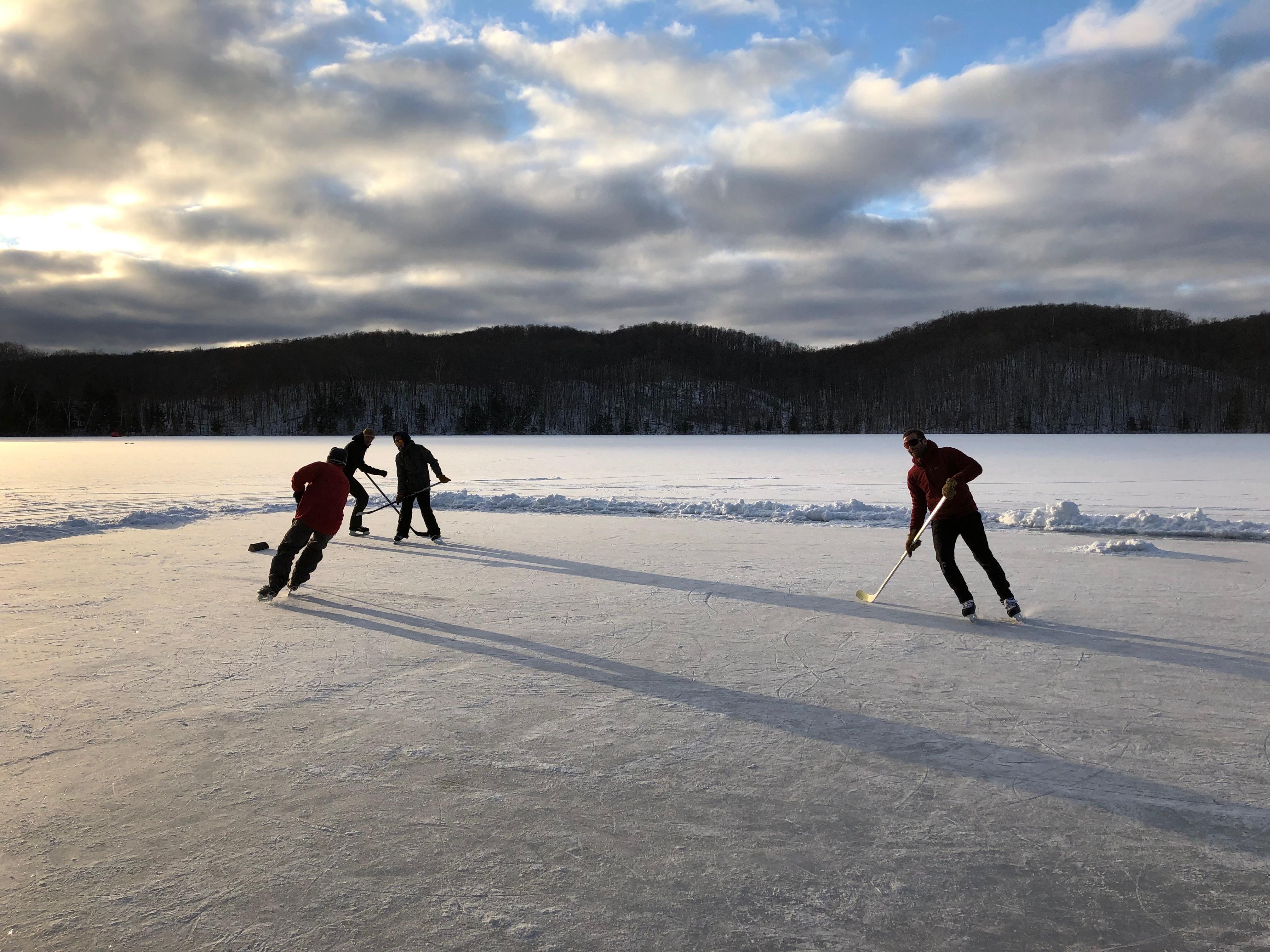
Northern New Jersey, where I grew up, sometimes had skateable outdoor ice. But the conditions needed for decent ice—three nights of sub-twenty-degree weather, with little or no surface-marring snow—were rare. We averaged about a half dozen days of good ice per winter.
When the ice was good, and I wasn’t at school or basketball practice, I skated as much as I could. I thoroughly enjoyed it. Memories of natural ice time are among my outdoor favorites, both as a kid and as a grown-up. Skating is a unique form of motion. You can accelerate quickly, glide, cross-over, do tight turns, spin, back-skate and stop suddenly and snowily. The cold air on your face and in your nose are invigorating. Adding in stick and puck makes things more challenging and fun.
When I was 11, my friend, Skip, and his father took me ice fishing. It was a primal experience. On a mid-sized lake tucked in the woods 25 miles from Manhattan, his dad hand-augered holes through the thick ice and set up a widely-spaced array of simple wooden, 3-D cross-like devices called “tip-ups.” When a fish would “hit” a submerged line, a spring would release a bowed wire and cause a small red pennant to stand up, such that it was visible from 100 yards. (I read that today’s triggered tip-ups send a text to your cell phone. Ugh.) We spent the day shuttling between the foot-wide apertures to see if we’d caught any pike or pickerel. I was awed that fish lived under the ice and that you could take them home and eat them.
My family lived 100 yards from a swamp. Most winters, on a chosen, cold January night, word of mouth would go out that people in our modest neighborhood should tote their Christmas trees to the icy swamp’s edge for a bonfire. Using the trees for warmth and fuel, the grown-ups made hot chocolate and served it to us kids, who skated by the light of the moon and the fire. And the earth did not swallow them.
The swamp was connected, through an ice-floored maze of trees and reeds we called “The Channel,” to a river that connected to the next two towns. On our coldest days we had, like the Joni Mitchell song, a river to skate away on.
Most of all, I loved playing pick-up hockey or keep-away games on swamp and later, lake or canal, ice. The first two winters, I had to wear my sister’s hand-me-down white figure skates that my mother had masculinized with black shoe polish. This veneer wore off as the ground-up ice wettened my skates and dissolved the dye.
If the dads showed up on weekends, we played keep-away against them, chasing a puck around and, if we had lost our pucks in the brush and brown leaves along the periphery, vying for a crushed soda can. I can still hear the sound of skate metal cutting ice and crumpled aluminum scraping at the end of wooden hockey sticks.
When we moved across town, we played on the wide, shallow lake at our town’s Industrial Park. In the winter, hundreds of people flocked there, as migratory birds do to their feeding grounds. I would see people there who I didn’t see the rest of the year, or sometimes for several winters. Over the years, people went to college, got married and had their own kids, whom they brought along to teach how to skate and play hockey with. The seasons, they go ‘round and ‘round.
In the eighth grade, I broke my leg. I had a full-leg cast for two months. Our week-long February school break was ice cold. My friends played Industrial Park hockey every day. It frustrated me to be stuck in the house. But I was happy for my pals, taking advantage of this time-limited opportunity. In the same way, during Coronamania, the old should have spoken against sacrifices by the non-old, ostensibly to save grandma and grandpa. Just because some felt threatened and withdrew from human interaction doesn’t mean that others should do so.
One winter weeknight during one of the years I had dropped out of college, I went with four friends to a cozy, old, local bar. A burly, curly-black-haired and bearded acoustic guitar player with a pleasingly raspy voice played some raucous covers above the din of a full house of standing, yakking beer drinkers happy to gather with others when it was cold outside and the sun set before the workday ended. With all that loud, close talking, plenty of microbes were exchanged. No one cared.
At closing time, one of my friends and I spontaneously agreed to go to the Industrial Park. Starting at 2:30 AM, we skated for two-plus hours, often hearing booming, spectral expansion cracks as the temperature dropped below ten degrees. Eventually, we made a small fire in a hidden cove, discussed the things that earnest twenty-year-olds discuss, and hatched a plan to quit our jobs and backpack through Europe together. We went home, napped briefly and went to our respective workplaces. In mid-April, we bought $135 one-way stand-by tickets from Laker Airlines and fulfilled our lakeside pledge. If there had been a viral travel ban, that once-in-a-lifetime trip wouldn’t have happened. We wouldn’t even have had jobs.
I have many great memories of ice time. Some are aesthetic, others are kinesthetic. These will last forever, even when I become too old to squeeze my bare feet into my beat-up CCM 652s.
Yeah, you can skate at a rink. But doing it outside, under the sky and among the trees, birds and breezes, is better.
—
As the decades have passed, in most public spaces, public officials post signs that say “NO SKATING” or the less imperious, but functionally peremptory “NO SKATING UNLESS THE FLAG IS UP.” They never put the flag up, even when the ice got thick enough to hold a car: six inches. Ice floats; the water beneath it exerts a buoyant force.
This unrealistic ice thickness standard resembles that of Covid officials who teased Americans with a return to normal if the number of “cases” shrank to some arbitrary and, given the absurdly low viral detection threshold, unattainable level, reflecting some amorphous public health goal.
In both the skating and viral contexts, officials act as if they’re protecting the public—presumed incapable of risk assessment—from peril. But really, pols and bureaucrats just love to boss people around. How many skaters fall, or used to fall, through the ice and die? How many healthy people under 70 died of Covid? Ultimately, at what cost to human happiness are healthy people ordered to keep off the ice and forgo other activities that gave them joy and memories?
Getting out and moving with others—especially in winter, when many become sedentary—improves vitality and mental health. Keeping people from skating and doing other things that made them happy made them less healthy. (In the summer, we often swam in lakes on state and county land with “"NO SWIMMING” signs). By “just saving one life,” or pretending to, how many millions of other lives are diminished?
—
After moving to Central Jersey, I’ve seen “NO SKATING” signs adjoining every body of water that I know of. To evade such wintry authoritarianism, I drive 30 miles to a Pennsylvania canal and hike another twenty minutes into the woods to get to my glassy haven. I’ve immensely enjoyed skating there. One January 2021 afternoon, two hikers passed. They offered to take a short video of me skating and emailed it to me. I forwarded it to friends with this note: “Thank God for this place, a stick, a puck, skates and two good legs. I saw a dead sunfish under the ice. It was probably Covid.”
It was, after all, the Winter of Death.
—
Returning to my hometown’s Industrial Park one January day as a 32-year-old, I smacked around the black biscuit with a neighbor, Joe, whom I’d played with as a teen. Joe still skated strongly. But he got melanoma that spring and died that fall, at 33. All-Irish Joe had been a lifeguard in his teens and early twenties. They say there’s a melanoma epidemic. If public health officials want to eliminate melanoma, maybe they should start clearing the beaches and public pools at mid-day. And make everyone apply SPF-50 sunscreen under lifeguard supervision. Or just ban pale people, for their own good. Safety first, right?
Dean, another friend with whom I’d played pond hockey with as a teen, was killed in a car wreck when he was 20. Over 6,000 American drivers under 25 are killed in crashes every year. If raising the driving age to 25 just saves one life, isn’t it worth it?
These two and many other examples show that, when it has wanted to, America has often balanced risk and reward, accepted that some deaths will be caused by some activities, even among people who are too young to die.
Socrates said the unexamined life is not worth living. I say the same about the voluntarily passive or unduly restricted life.
—
In The Gulag Archipelago, Solzhenitsyn writes that the gulag system’s brutality was ultimately enabled by ideology. Convincing themselves that their actions served some greater good, the veks (wardens/guards) justified their vicious mistreatment of zeks (prisoners).
Today’s public officials use the phony ideology of “public health” and “safety” to justify petty and grand oppression and gross misallocations of societal resources. Pathetically, many of the people stepped upon by the “public health” apparatus, and its self-aggrandizing jargon, hail their bureaucratic and political oppressors for illusorily protecting them. Stockholm Syndrome.
Outdoor ice skaters don’t need government protection. Ice isn’t that dangerous. The internet falsely declares that four inches are needed to hold a 200-pound person. I weigh more than that and I’ve often skated on two inches without breaking through. Besides, the places that freeze fastest have shallow water. Even if you fall in, you’re not likely to get anything but a wet foot. Worst case scenario, two wet legs.
The Covid restrictions were similarly unwarranted and even more excessive. The virus wasn’t that dangerous. If a healthy person got sick and avoided hospital mistreatment, their immune systems cleared the infection, as with the flu.
Those who didn’t buy the panicky narrative shouldn’t have had to follow the one-size-fits-all rules that the propagandists set. Those who knew that their birth certificates, not their masks or mRNA injections, protected them from Covid, should have been allowed to assess their own risks and live as they pleased. The six-foot social distancing standard had even less basis than the six-inch, safe-ice rule. Experimental injections for those healthy and under 70 didn’t even bear consideration. Nor, if you ask me, at any age.
While public safety officials have deemed outdoor skating dangerous, you can buy and use as much alcohol, tobacco and weed, and eat as much bad food, as you want. No one screams at anyone entering places where they buy unhealthy stuff. And if your mask or shot protects you, why do you care if I don’t mask or inject?
But somehow you can’t skate on a three-foot-deep pond. It’s too dangerous.
People should be allowed to assess and assume more of their own risks and accept the consequences of doing so. The pendulum of “public health” paternalism, given much additional, grossly undue weight during the Scamdemic, needs to swing strongly back the other way.
Well, this isn't about ice skating (though I'm old enough to have done that back in the day, on the C&O Canal near Georgetown), but during the first COVID summer of 2020, when everything was locked down -- you even weren't allowed to take your boat out onto the Chesapeake Bay -- I decided to go for a solitary hike one day, to break the lonely monotony...
.... and I came upon a young father and his perhaps 6yo daughter, sliding down a natural waterfall/rock formation into a cool pool of water in a wide stream. Around and around she went, sliding, splashing, laughing, with dad standing right there, nearby. He and I struck up a conversation, about how ridiculous it was that everything was closed -- all of the playgrounds, swimming pools, anything normal that a young person would naturally want to do.
While I was so happy to stumble upon this little family, it also left me with a great sense of grief, because this had already been going on way too long.... way beyond the "2 weeks to flatten the curve" nonsense. It had been about 3-4 months by this point, with no sign of letting up.
And while it was great to see this father and daughter enjoying the beautiful day, I thought about the other kids who weren't there also taking advantage of this natural playground, hidden away in the woods from the officials who, if they had thought or known about it, might have put up their yellow caution tape and "forbidden" signs.
Many of the public health guides that were out pre-2020 and cited during 2020 declared that the public health safety protocols were a product of "Equity." If a morbidly obese diabetic or unwell elderly person had been subjected to targeted interventions that would scream discrimination. It would've facilitated an 'inequity.'
So the broad community-wide restrictions, even on the healthy and fit, were necessary for 'Equity' and 'Ableism' concerns. "We're in this together!" "Don't you care about others who aren't as fortunate as you?!?!"
Proving Churchill's observation that the only thing Socialism shares equally is misery.